Magazin “Politika Magazin”

Magazin “Politika Magazin”
28.12.2025
Slavica Stuparusic
NOT JUST ABOUT BUSINESS: VLADIMIR PESIC
Quality and Emotion Cannot Be Forged
The collector and connoisseur of Russian art has spent nearly four decades building a collection dispersed across Serbia, Russia, Latvia, and London. His passion for painting and icons is not merely personal – it is also a cultural mission.
A collector and outstanding expert on Russian art, Vladimir Pesic has been building his collection for a full 36 years, with works now spread between Serbia, Russia, Latvia, and London. In an interview with Magazin, he reveals how he began this journey, what inspires him, and why he believes that art cannot be forged.
We met at the Salon of the Belgrade City Museum, where the exhibition “Constellation of Distinguished Russian Artists of the 19th–20th Centuries from the Collection of Vladimir Pesic” was being held. The exhibition featured 36 paintings and eight icons created at the end of the 19th century.
Dressed in a black suit, with a tie and a pocket square tucked into the breast pocket of his jacket, Pesic not only appeared refined and elegant, but also demonstrated respect for the profession practiced by his father. Dušan Pesic (1932–2019) served as Politika‘s correspondent in the United Kingdom, France, the USSR, and the United States for three decades, from 1966 to 1996. When he was not posted abroad, he worked successfully as a commentator, editor of the foreign affairs section, deputy editor-in-chief, and for a period also as deputy director of the publishing house Politika.
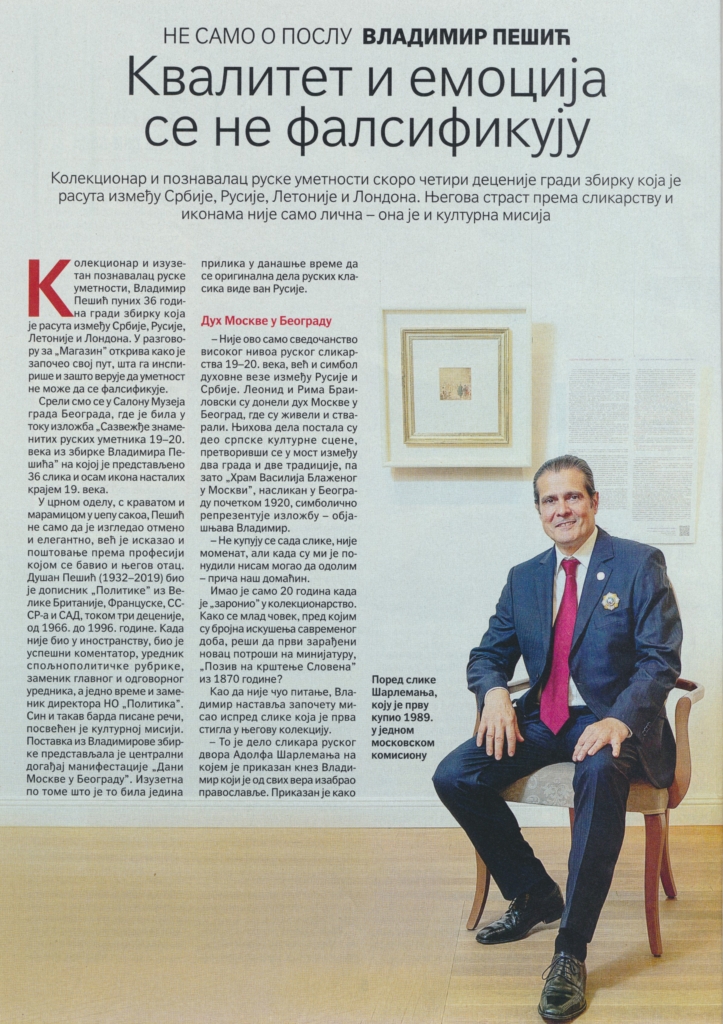
The son of such a distinguished master of the written word has devoted himself to a cultural mission. The exhibition drawn from Vladimir’s collection was the central event of the “Days of Moscow in Belgrade” festival. It was exceptional because it represented the only opportunity in recent times to view original works by Russian masters outside Russia.
The Spirit of Moscow in Belgrade
“It is not merely a testament to the high standard of Russian painting of the 19th and 20th centuries, but also a symbol of the spiritual bond between Russia and Serbia. Leonid and Rima Brailovsky brought the spirit of Moscow to Belgrade, where they lived and created. Their works became part of Serbia’s cultural landscape, transforming into a bridge between two cities and two traditions. That is why St. Basil’s Cathedral in Moscow, painted in Belgrade in the early 1920s, symbolically represents the exhibition,” Vladimir explains.
“People are not buying paintings these days – it is not the right moment – but when it was offered to me, I simply could not resist,” says our host.
He was only twenty years old when he “immersed himself” in collecting. How does a young man, faced with all the temptations of the modern age, decide to spend his first earnings on a miniature painting, The Call to the Baptism of the Slavs, created in 1870?
As if he had not heard the question, Vladimir continues his thoughts while standing before the painting that was the first to enter his collection.
“It is a work by Adolf Charlemagne, a painter of the Russian Imperial Court, depicting Prince Vladimir, who chose Orthodoxy from among all faiths. He is shown inviting the Polyans, a tribe that lived on the territory of Kievan Rus’, to embrace Orthodox Christianity. The land over which he ruled was called Kievan Rus’, although today the term Old Russian State is also used alongside that name. Its capital was Kyiv. This piece travelled with me around the world, protected against theft.”
The Stars of the “Constellation”
The question naturally arose: what is the most valuable piece in your collection, which now numbers more than 330 works of art?
“I have quite a few of them. I do not count them, because I select and acquire each one with great care and a strong desire to have it become part of my collection,” he says.
Last month, around eight thousand visitors saw the “Constellation” exhibition at the Belgrade Salon.
That is why our interlocutor says:
“Success means that, with the help of these paintings, I have managed to draw the public’s attention away from their phones; if I have encouraged them to go out into nature and see what the artist sees; if I have inspired them through the historical events depicted in the paintings or through deeply moving and instructive stories, such as that of Princess Mafalda of Savoy. The portrait of the Princess is the work of the renowned Kolesnikov, whom people here came to regard as one of their own. After the Second World War, every well-to-do family wanted to own one of his paintings. Mafalda was the daughter of King Victor Emmanuel and Queen Elena of Savoy, and the granddaughter of King Nicholas Petrović-Njegoš of Montenegro. She married Prince Philip of Hesse, grandson of the German King Frederick. She was accused of contributing to Mussolini’s downfall and of poisoning King Boris of Bulgaria. She was arrested and taken to a concentration camp in Germany, where she perished during an air raid.”
The Princess’s portrait, set in an ornate frame, was presented to the public for the first time three years ago at exhibitions in Vršac and later in Belgrade.
“I choose the frames myself; framing is part of my work. I do not create artworks, but I make my contribution by ensuring that paintings are restored, conserved, and preserved in good condition for future generations,” he adds.
Works from his collection have been exhibited at numerous exhibitions and in antique salons in Moscow. Pesic also provides financial support to museums and has been awarded the title of ‘Friend of the Latvian National Museum of Art.’
He is also engaged in consultancy services related to the acquisition of artworks.
“For the first ten years or so, I never purchased anything without the assistance of art historians and experts, so as not to make mistakes. Over time, I learned to distinguish quality for myself. Quality cannot be forged.”
When we remarked that he seemed like an encyclopedia, much like Wikipedia, he admitted with a smile that he possesses an extensive library: encyclopaedias, catalogues, and numerous publications related to the visual arts.
At the exhibition opening, Sergey Cheryomin, Minister of the Moscow Government, shared an interesting detail with us: Vladimir graduated from Moscow School No. 1231, named after V.D. Polenov.
“At the age of only sixteen, he enrolled at the Maurice Thorez Institute, which at that time was almost an unimaginable achievement. I myself attempted to enroll at a Moscow university and succeeded only on my fourth try.”
“My father worked in London for a period, and I was born there. I took my first steps in Paris, and at the age of six and a half I started school, which I later continued in Belgrade. From the fourth through the eighth grade, I attended the Vladislav Ribnikar School. Afterwards, we moved to Moscow, where I completed the ninth and tenth grades.
Moving to Moscow was a shock. By October, there was already snow. Milk was sold in a dairy shop five hundred meters from our home, while the bread shop was another five hundred meters away in the opposite direction. Those were difficult years in the Soviet Union. We lived in diplomatic compounds. We were allowed to travel only within a fifty-kilometer radius of Moscow; any journey beyond that required special permission. In geography textbooks, Yugoslavia was classified as a capitalist country. During the 1980s, a foreigner in Russia was considered something of an exotic rarity, and people were also afraid that they might get into trouble if they communicated with us.”
That, we note, is also the time of first loves.
“Yes, and she was a girl from Banja Luka. I met her on Cres Island. Because of her, I ran away from home at the age of fourteen. Every month, my father gave me a certain amount of money, and in return I had responsibilities such as taking out the rubbish and cleaning my room. Using that ‘salary’ of mine, I bought a bus ticket to Banja Luka. Her name was Aleksandra. We spent a wonderful afternoon together, and then I took the overnight bus back to Belgrade.”
After completing his first year of university studies in Russia, he returned to Belgrade and continued his education there. At the age of seventeen and a half, he became the youngest student at the Faculty of Philology, studying French language and literature. However, he did not see his future in Belgrade, so he returned to Moscow to continue his third year of studies. By then, his father’s diplomatic assignment had ended and he had gone back to Belgrade, while Vladimir remained in Moscow to study and work.
According to him, foreigners could earn a good living in Russia at that time, whereas for Russians those were difficult years. With the first money he earned at the age of nineteen, he launched a porcelain production business.
“Artists made porcelain hearts decorated with roses and calla lilies. People with disabilities produced the boxes—several thousand of them. I took those hearts of mine to Sweden, thinking: if people are willing to pay ten euros for a beer, they will surely pay the same amount for a heart as a symbol of love. That was when I became disillusioned. Had that venture succeeded, perhaps I would never have started buying paintings.”
The Gorbachev Era
His passion for collecting dates back to childhood.
“I was fortunate that our family friend was the renowned surgeon at the Military Medical Academy in Belgrade, Academician and Colonel General Isidor Papo. He had an extensive collection of both postage stamps and paintings. When I was nine years old, he gave me a number of stamps and advised me to begin collecting those issued in the year I was born, 1969.”
The turning point in the formation and significant expansion of the family art collection came during Gorbachev’s perestroika, when, in 1988, the auction house Sotheby’s held its first art sale in Moscow. This event further intensified Vladimir’s interest in works of art. He purchased his first painting in 1989 from a Moscow commission shop. The very next year, in 1990, he began enthusiastically acquiring valuable paintings at auctions of Russian art in London. He also collects icons and unique antique objects.
Pesic’s goal and lifelong mission is to establish a museum and bring together his entire collection in Serbia. However, the greatest obstacle to achieving this lies in Serbia’s customs regulations, which impose a 10 percent customs duty and 20 percent VAT, amounting to a 30 percent burden on cultural property. He points out that such charges are significantly lower or non-existent in Russia and elsewhere in Europe, emphasizing that: “Countries that think about their future understand that the more cultural treasures they possess, the richer they become.”
We pause before the portrait of a young woman — Tamara Biba, painted by Alexander Tolstoy.
“She was the wife of my great-granduncle. She was Russian. She came to Belgrade as a young woman together with her mother. She used to visit my grandmother Ana, and they drank coffee together every day. She had no heirs, so she left her portrait to my mother.”
His mother’s family was of Aromanian (Cincar) origin. His great-great-grandfather, Andreja Dada (1828–1913), was engaged in trade during the same period as Captain Miša Anastasijević. At the end of the nineteenth century, he purchased a house at 21 Gospodar Jovanova Street, which was expropriated in 1953. Today, the Vuk and Dositej Museum is housed there. He owned several plots of land in Dorćol, and a three-storey building was constructed on Kapetan Mišina Street, which was nationalized in 1953. During the restitution process, Vladimir’s mother received fifteen percent of its value. He also reveals that his great-grandfather was a collector of Serbian artists and that the family is related to Uroš Predić.
Will any of his three children or five grandchildren inherit his passion?
“I’m not sure. It is something a person carries within themselves,” he says at the end of our conversation.
Golden Badge
In recognition of his longstanding contribution to the development of cultural activities, Vladimir Pesic was awarded the “Golden Badge” by the Cultural and Educational Association of Serbia in 2022.
In 2023, the Ministry of Foreign Affairs of the Russian Federation and Rossotrudnichestvo honoured him with the Medal for Strengthening Peace, Friendship and Cooperation, which was presented to him by Yevgeny A. Primakov.
“Whirlwind” Stirred a Sensation
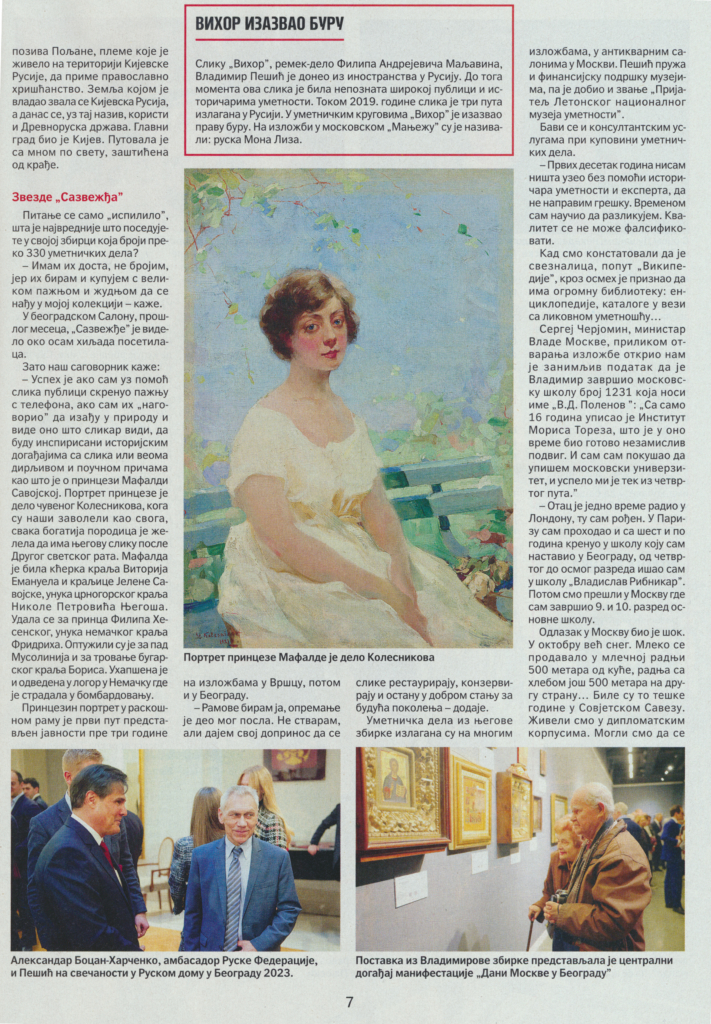
Vladimir Pesic brought the painting Whirlwind, a masterpiece by Filipp Andreyevich Malyavin, from abroad back to Russia. Until that moment, the work had remained unknown to the wider public and to art historians.
During 2019, the painting was exhibited three times in Russia. Within artistic circles, Whirlwind caused a genuine sensation. At the exhibition held at Moscow’s Manege, visitors and experts alike referred to it as “the Russian Mona Lisa.”
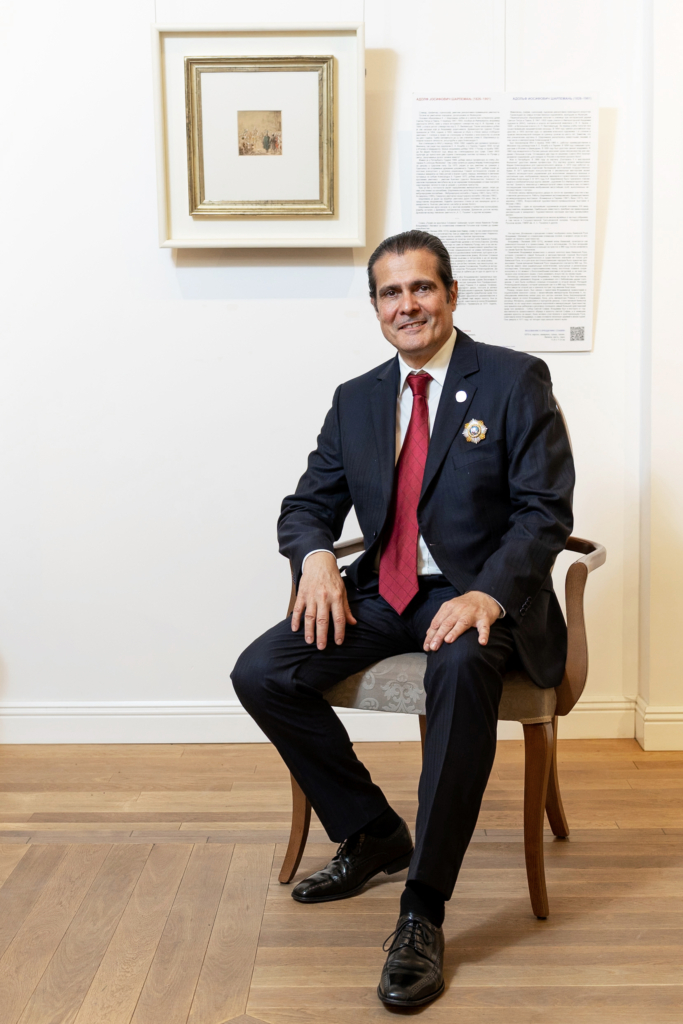
Vladimir Pesic, collector of works by Russian visual artists (Photographs from the personal archive)
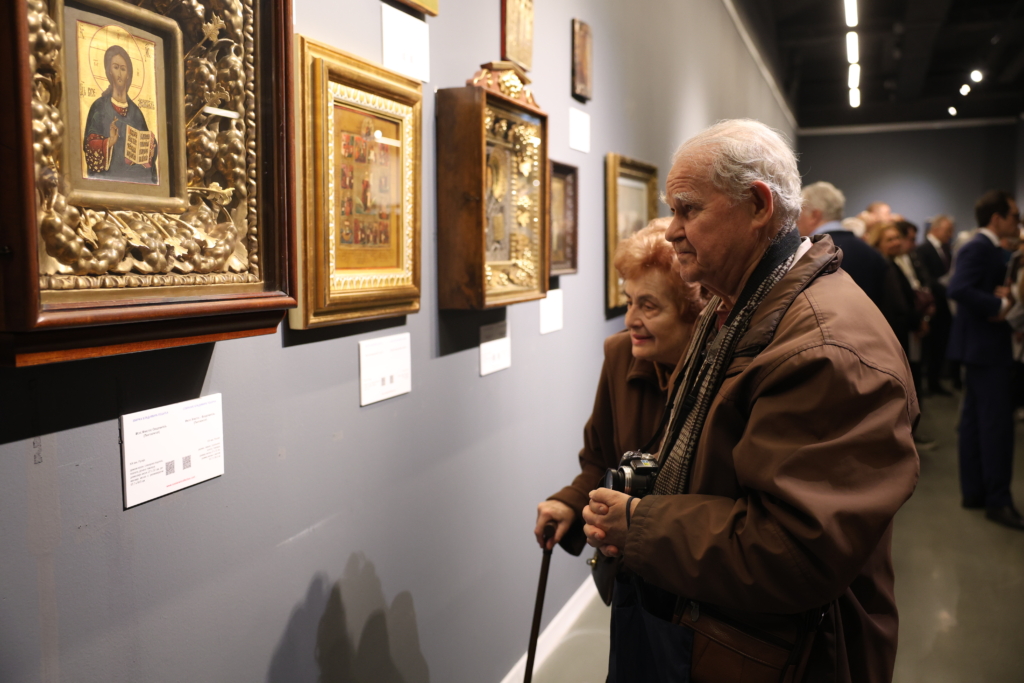
A display from Vladimir’s collection formed the central event of the “Days of Moscow in Belgrade” festival.
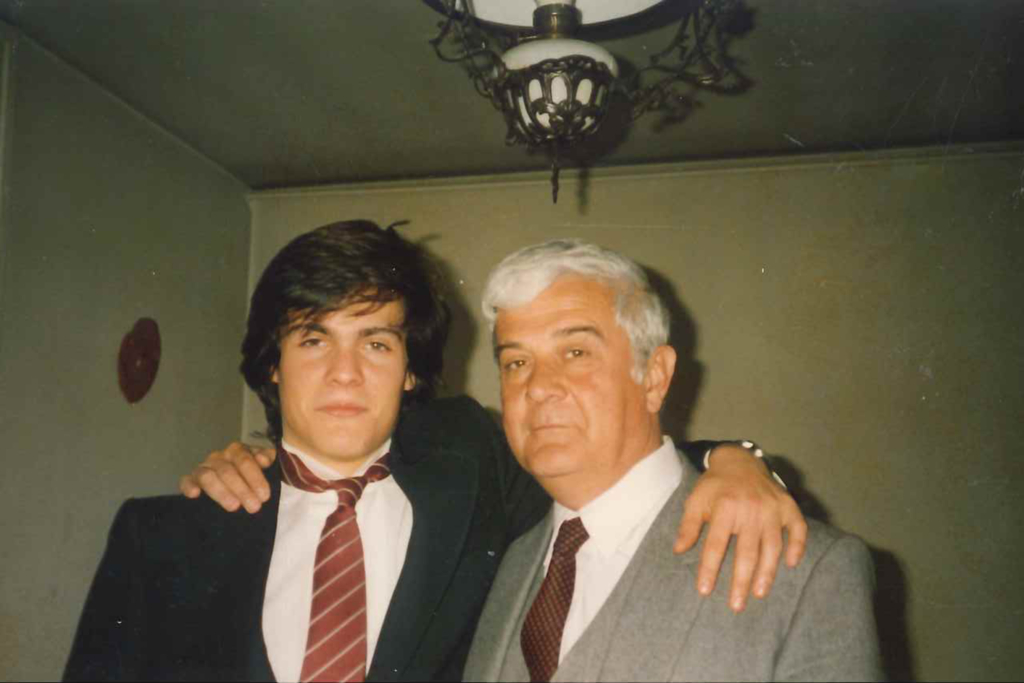
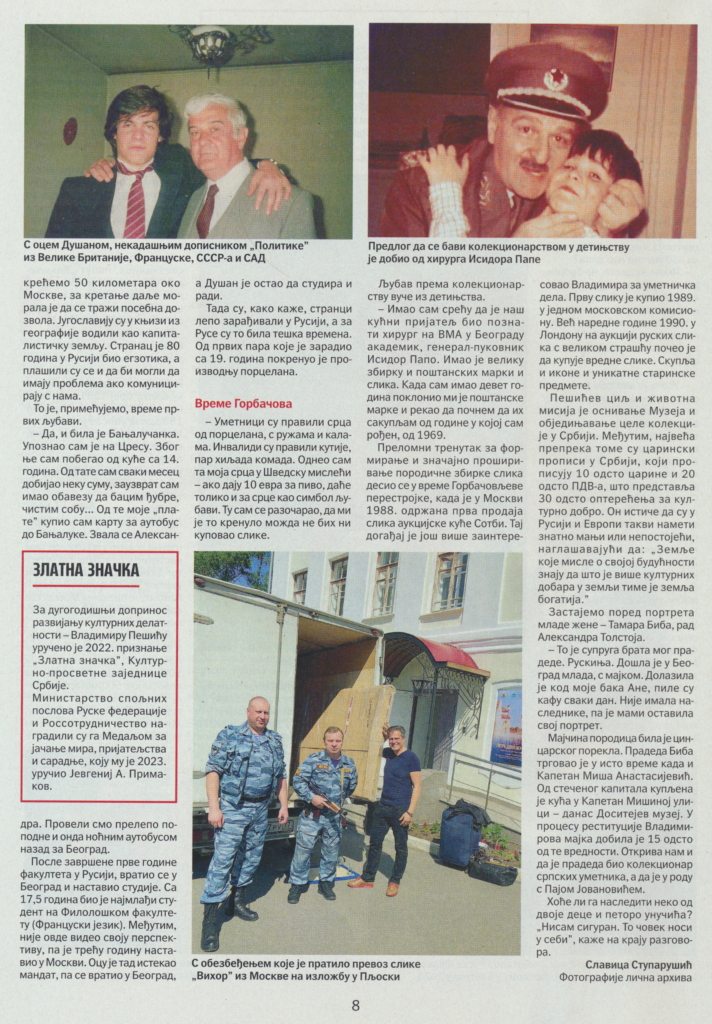
With his father Dusan, former correspondent of Politika in the United Kingdom, France, the USSR, and the United States.
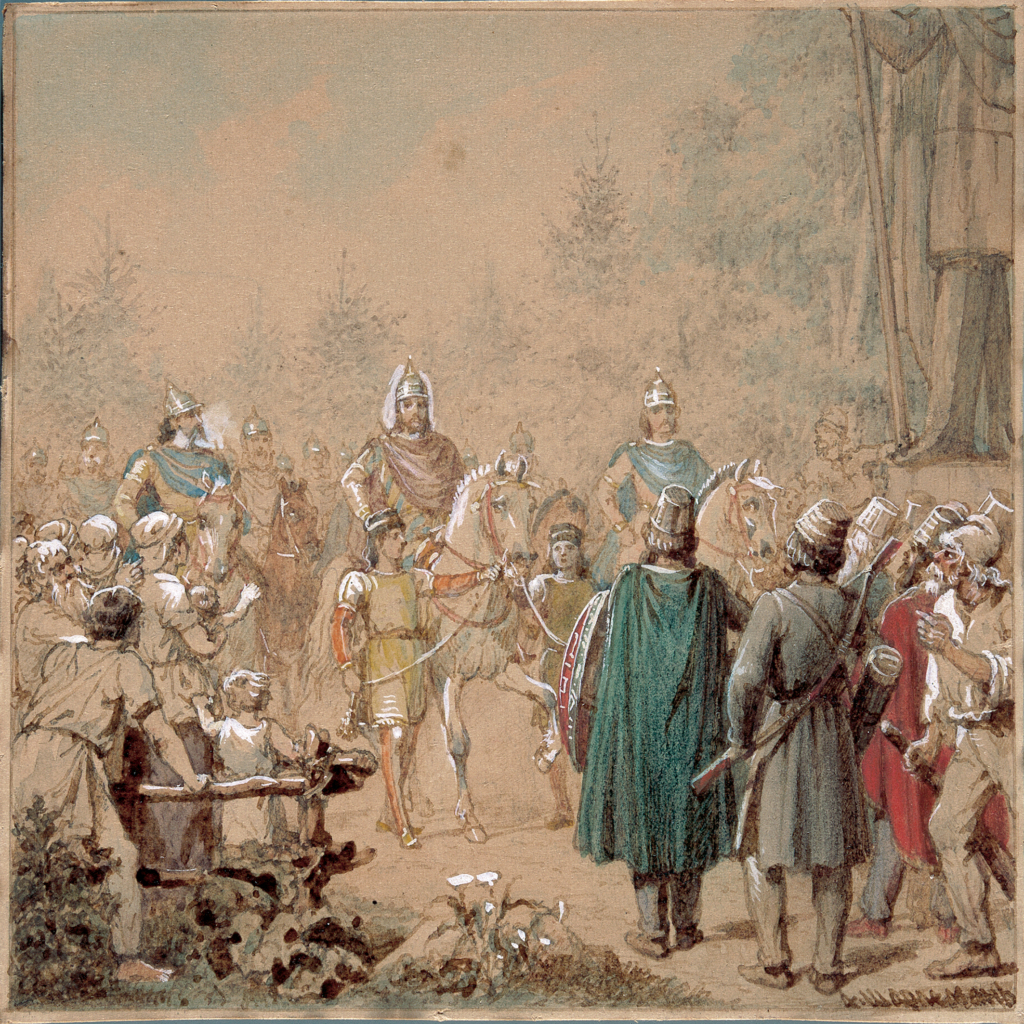
The Call to the Baptism of the Slavs, a miniature (11.8 × 11.8 cm) by Charlemagne, the first work Pesic purchased in 1989.
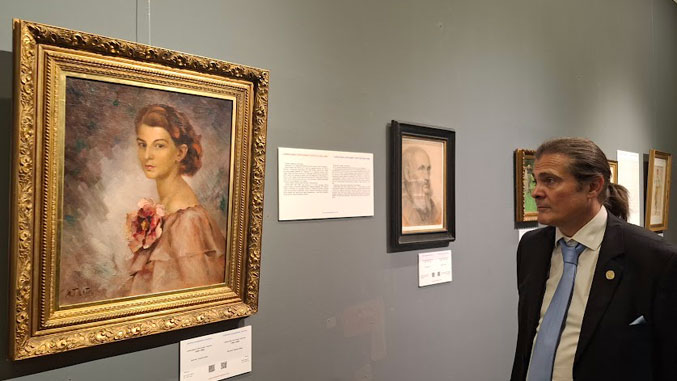
Tamara Biba, a work by Alexander Tolstoy
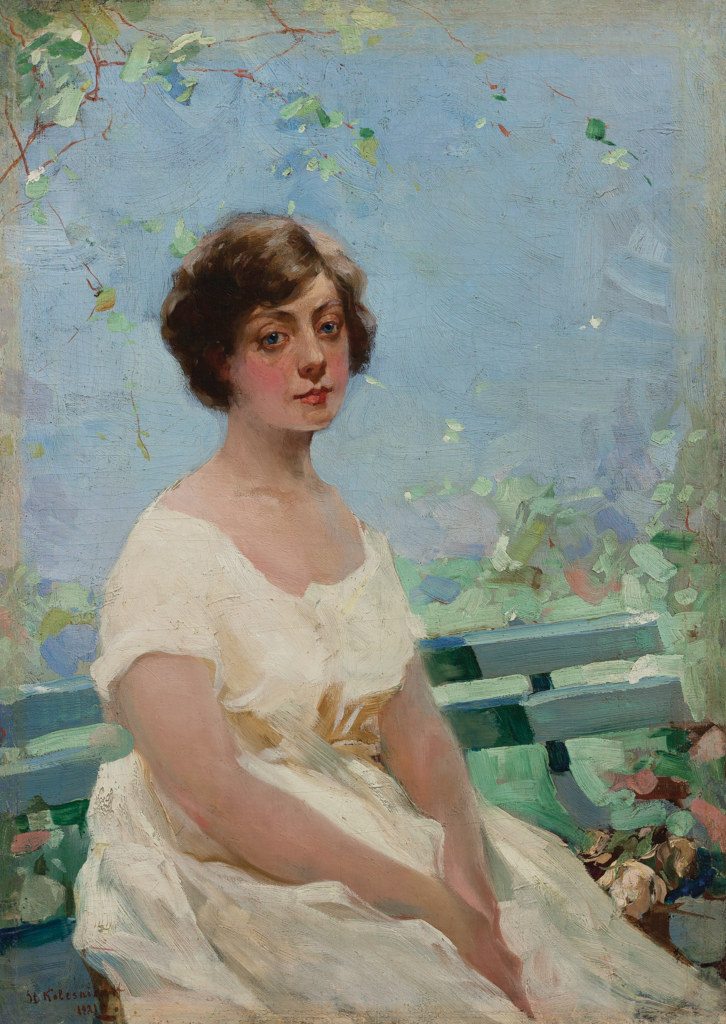
The portrait of Princess Mafalda is a work by Kolesnikov.
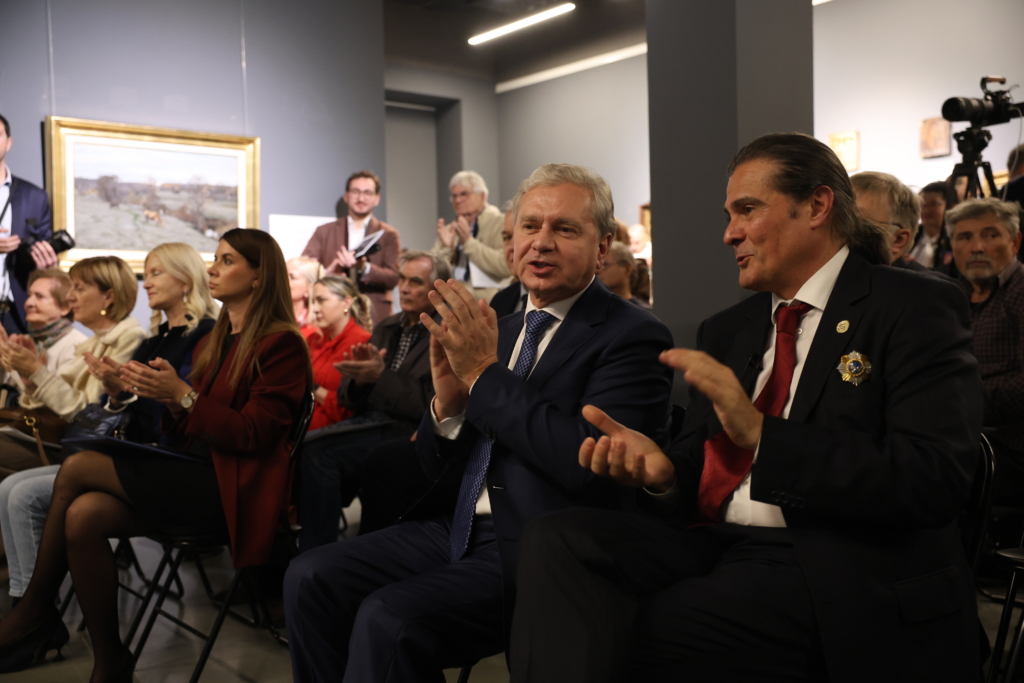
Sergey Cheryomin, Minister of the Moscow Government, at the opening of the exhibition “Constellation of Famous Russian Artists of the 19th and 20th Centuries from the Collection of Vladimir Peshich”
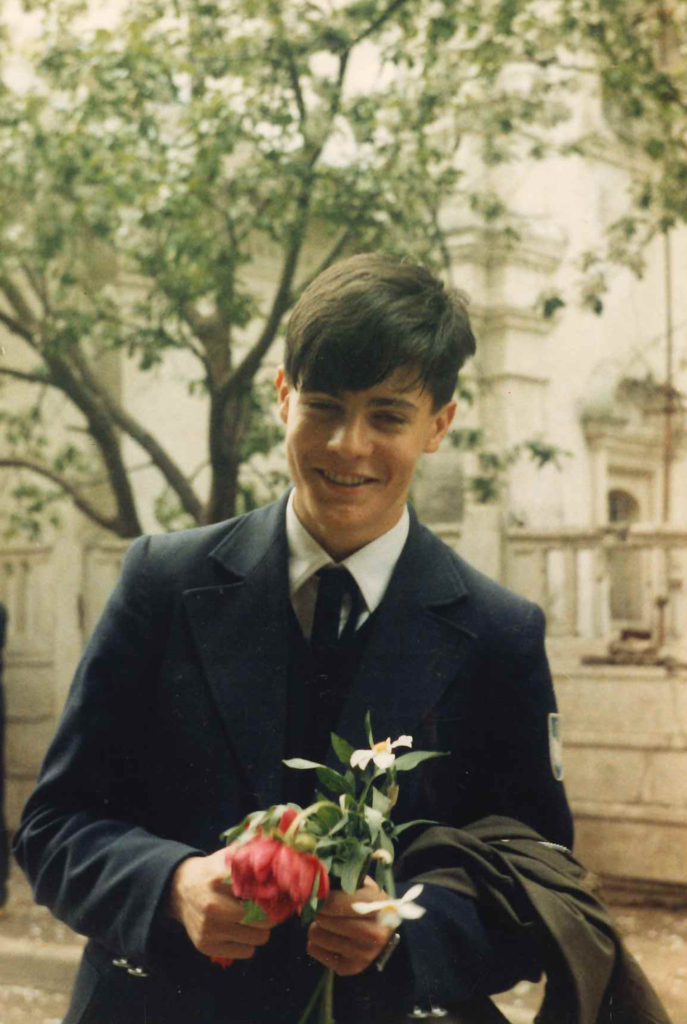
The last day of school in Moscow, known as the “Last Bell,” May 1985.
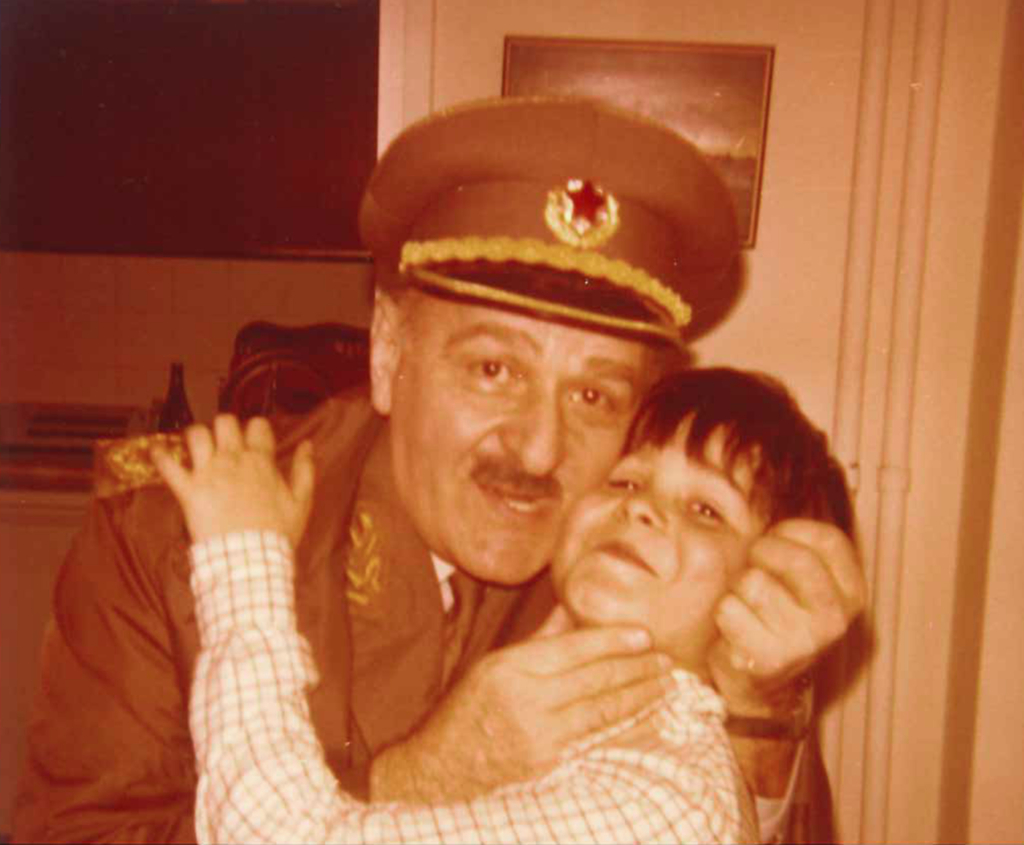
The suggestion to take up collecting in childhood came from the surgeon Isidor Papo.
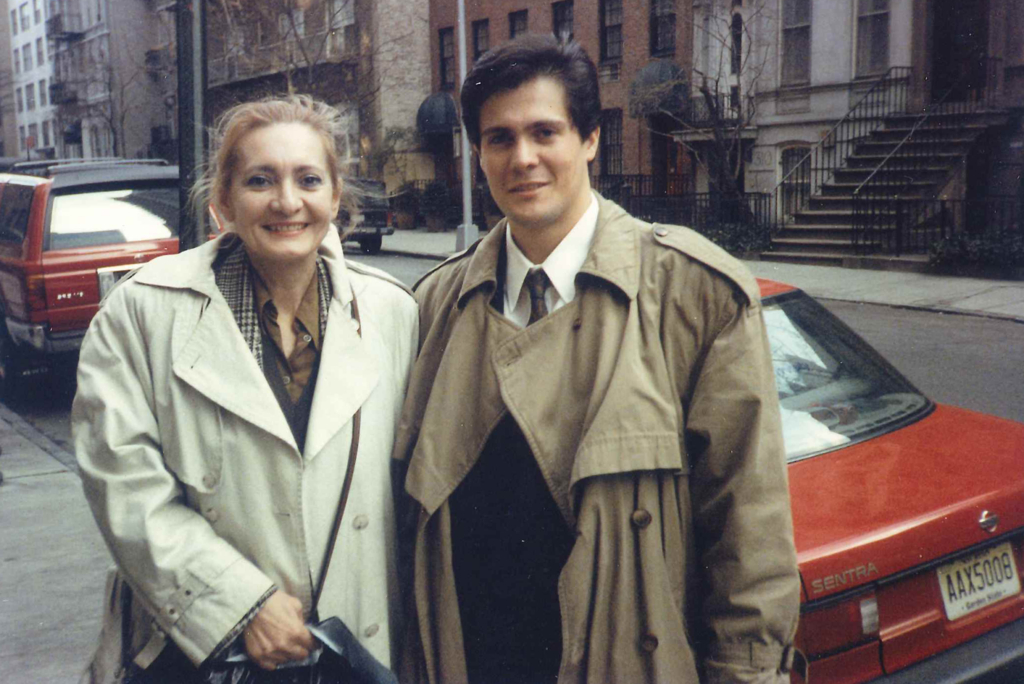
Vladimir with his mother Ivana, New York, 1992.
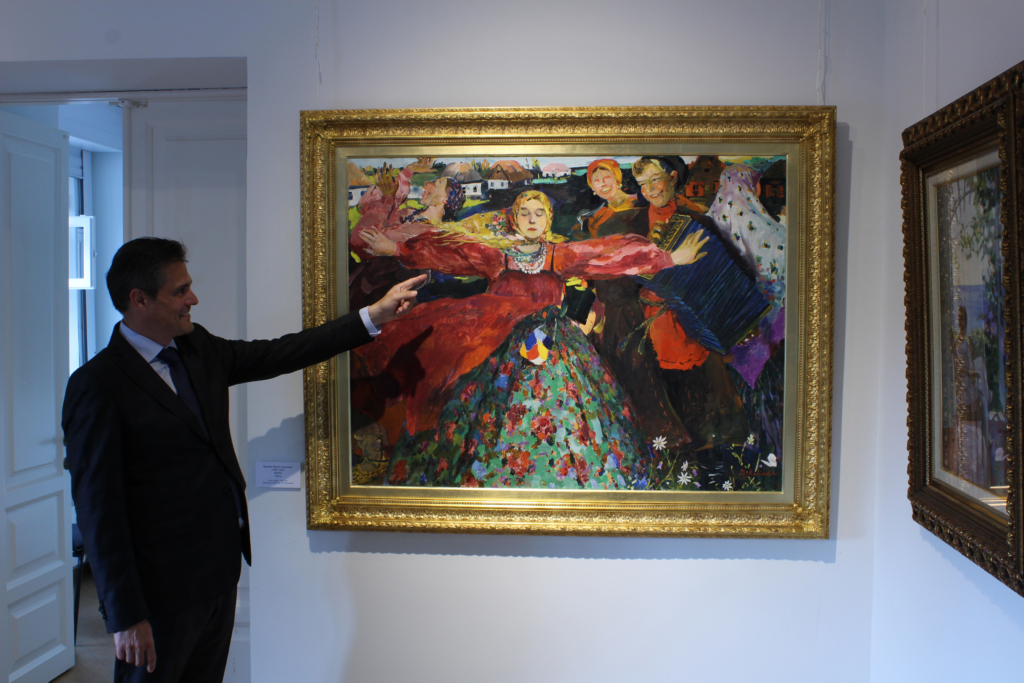
Whirlwind, a masterpiece by Filipp Andreyevich Malyavin.
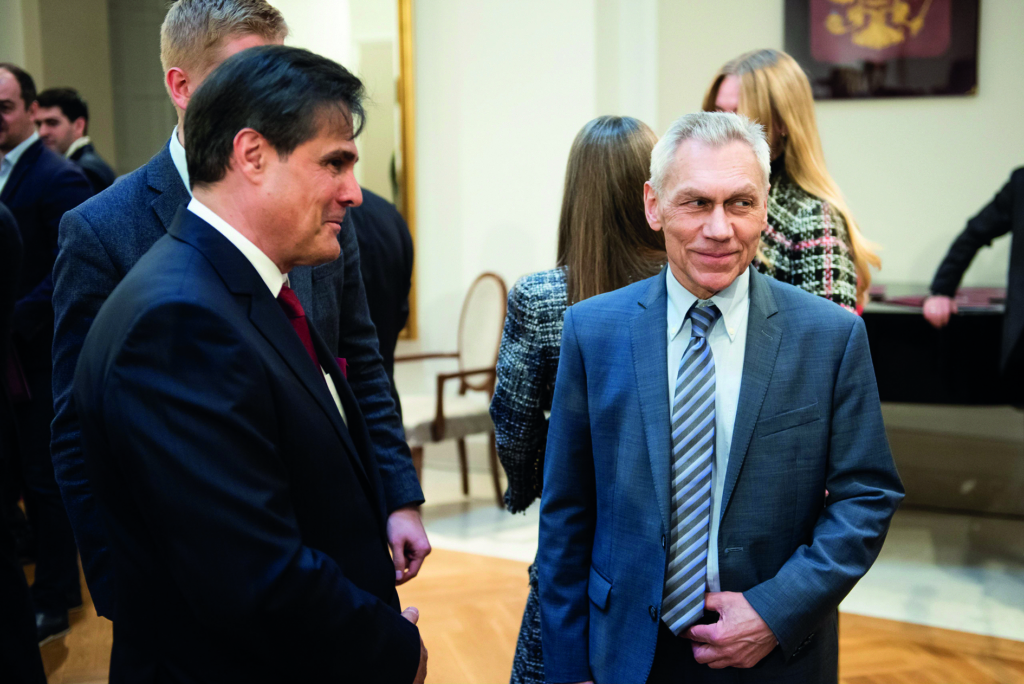
Alexander Botsan-Kharchenko, Ambassador of the Russian Federation, and Pesic at a ceremony held at the Russian House in Belgrade in 2023.
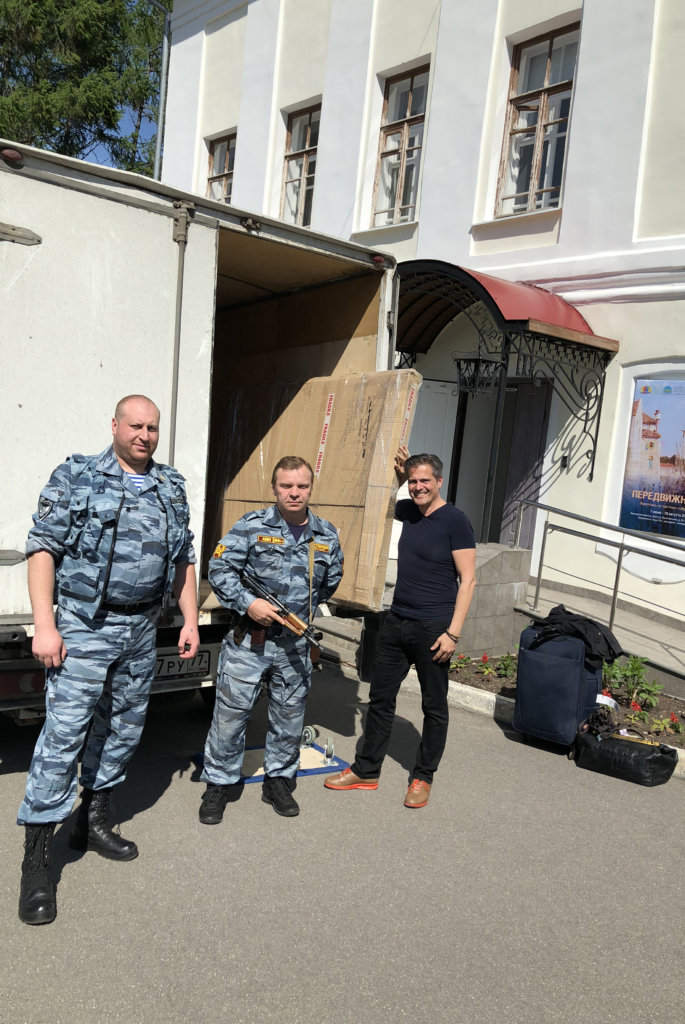
With the security team that escorted the transportation of the painting Whirlwind from Moscow to an exhibition in Plyos.
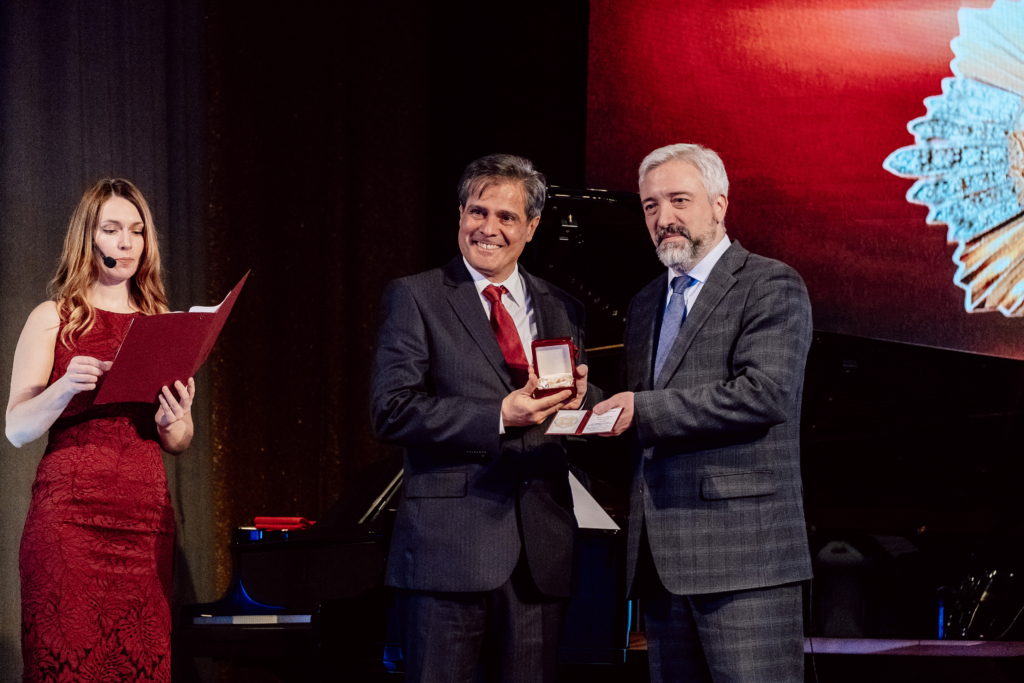
The Medal for Strengthening Peace, Friendship and Cooperation was presented to Vladimir Pesic by Yevgeny A. Primakov.