Večernje novosti

Večernje novosti
Miljana Kralj
May 19, 2026
“Shining Domes” by Grand Duchess Olga Beneath the Eiffel Tower
The exhibition “The Splendor of Russian Painting of the 19th–20th Centuries. Masterpieces from the Vladimir Pesic Collection,” will open in the French capital from tomorrow.
A curated selection from the most significant collection of Russian art outside the borders of Russia — comprising more than 330 paintings, works of decorative and applied art, icons, and unique antique ivory objects — assembled with dedication over the course of thirty-seven years by Vladimir Pesic, will be presented to the public of the French capital starting tomorrow. With the exhibition “The Splendor of Russian Painting of the 19th–20th Centuries. Masterpieces from the Vladimir Pesic Collection,” the Russian Orthodox Spiritual and Cultural Center in Paris will celebrate its tenth anniversary.
According to Pesic, the exhibition was conceived as a visual journey through 150 years of Russian art history. Eighteen carefully selected works will represent twelve major movements in Russian art, ranging from Realism, Impressionism, Post-Impressionism, and Russian Modernism to the Neo-Russian style, Cubism, Cubo-Futurism, Suprematism, Constructivism, Socialist Realism, Nonconformism, and Expressionism.
“All the works possess exceptional artistic value — they are masterpieces and works by outstanding artists,” Pesic emphasizes, noting that all of these works will be shown publicly for the first time.
As the export of museum objects was temporarily suspended by decision of the Ministry of Culture of the Russian Federation in 2022, the Vladimir Pesic Collection in France represents a unique opportunity for Russian artistic heritage to be presented to the world. The last major exhibition of Russian art in Paris took place four years ago — “The Morozov Collection: Icons of Modern Art” at the Fondation Louis Vuitton, which opened five years ago.
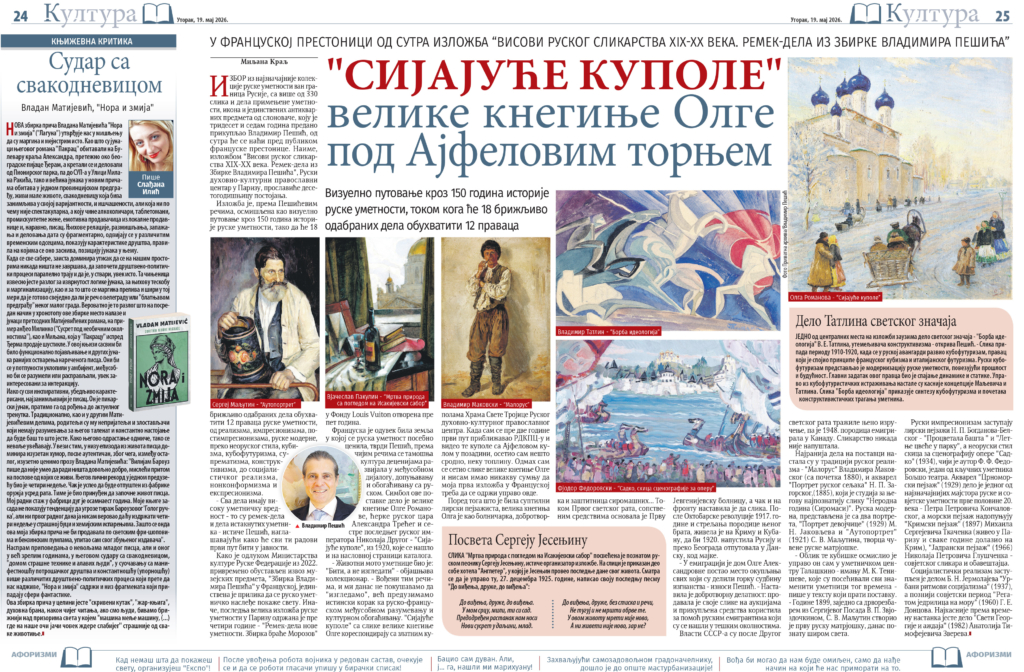
France has always been a country in which Russian art was especially appreciated, says Pesic, whose view is that French and Russian cultures developed for decades in a mutual dialogue of enrichment and exchange. The symbolic centerpiece of the exhibition is the painting “Shining Domes” (1920) by Grand Duchess Olga Romanova, daughter of Tsar Alexander III and sister of the last Russian Emperor Nicholas II, which also appears on the cover of the exhibition catalogue.
“The artist’s life motto was: ‘To be, not to pretend,’” explains the collector. “Guided by these words, we are not trying merely to ‘appear,’ but rather to take a genuine step toward Russian-French mutual understanding and cultural enrichment. The shining domes in Grand Duchess Olga’s painting resonate with the golden domes of the Holy Trinity Cathedral of the Spiritual and Cultural Orthodox Center. When I first approached the Center two years ago and saw those domes with the Eiffel Tower in the background, I felt something deeply familiar — a certain warmth. I immediately thought of the Grand Duchess’s painting and had no doubt that my first exhibition in France should take place precisely here.”
In addition to being a subtle lyrical landscape painter, Grand Duchess Olga was also a nurse, philanthropist, and protector of the poor. During the First World War, she founded the First Evgenievsky Hospital with her own funds and continued painting even at the front. After the October Revolution of 1917 and the execution of her brother’s family, she lived in Crimea and the Kuban region before leaving Russia in 1920 and traveling through Belgrade to Denmark, where her mother resided.
“In exile, Olga Alexandrovna’s home became a gathering place for all those who shared the bitter fate of displacement,” Pesic
recounts. “She continued her charitable work: she sold her paintings at auctions and used the proceeds to support Russian émigrés facing difficult circumstances. After the Second World War, the Soviet authorities demanded her extradition, and in 1948 the family emigrated to Canada. She never abandoned painting.”
The earliest works in the exhibition were created within the tradition of Russian Realism: “Little Russian” by Vladimir Makovsky (early 1880s), and the watercolor “Portrait of a Russian Peasant” (1885) by N. P. Zagorsky, a study for his most famous painting “The Lean Year (The Poor).” Russian Modernism is represented by two portraits: “Portrait of a Young Girl” (1929) by M. N. Yakovlev and “Self-Portrait” (1921) by S. V. Malyutin, creator of the famous Russian matryoshka doll.
“The shape of that wooden doll was conceived by Malyutin himself at the Talashkino art center — the estate of M. K. Tenisheva, visited by all the prominent artists of the time,” states the text accompanying the exhibition. “In 1899, together with the woodcarver V. P. Zvyozdochkin from Sergiyev Posad, S. V. Malyutin created the first Russian matryoshka, today known throughout the world.”
Russian Impressionism is represented by the lyrical landscapes of N. P. Bogdanov-Belsky — “Blooming Garden” and “Summer Flowers in the Park.” The Neo-Russian style appears through a stage design sketch for the opera “Sadko” (1934) by F. F. Fyodorovsky, one of the leading artists of the Bolshoi Theatre. The watercolor “Black Sea Landscape” (1929) is the work of one of the most important masters of Russian and Soviet art of the first half of the twentieth century — Pyotr Petrovich Konchalovsky. This maritime theme is complemented by “Crimean Landscape” (1897) by Mikhail Sergeyevich Tkachenko, who lived in Paris and visited Crimea every year, and “Adriatic Landscape” (1966) by Nikolai Petrovich Glushchenko — Soviet painter and intelligence officer.
Socialist Realism is represented by B. N. Yermolayev’s “Urban Rhythms of Socialism” (1937), while the later Soviet period appears through “Regatta of Sailing Boats at Sea” (1960) by G. E. Dontsov. The most recent work in the exhibition is “Saint George and the Dragon” (1982) by Anatoly Timofeyevich Zverev.
Dedication to Sergei Yesenin
The painting “Still Life with a View of Saint Isaac’s Cathedral” is dedicated to the renowned Russian poet Sergei Yesenin, the exhibition organizer points out. The work depicts part of the room in the Angleterre Hotel where Yesenin spent the final days of his life. It is believed that there, on December 27, 1925, he wrote his final poem, “Goodbye, my friend, goodbye.”
Goodbye, my friend, goodbye
My love, you are in my heart.
It was preordained we should part
And be reunited by and by.
Goodbye: no handshake to endure.
Let’s have no sadness — furrowed brow.
There’s nothing new in dying now
Though living is no newer.
A Tatlin Work of Global Importance
“One of the central places in the exhibition is occupied by a work of global significance — ‘The Struggle of Ideologies’ by V. E. Tatlin, founder of Constructivism,” reveals Pesic. “The painting belongs to the period between 1910 and 1920, when Cubo-Futurism emerged within the Russian avant-garde — a movement that united the principles of French Cubism and Italian Futurism. Russian Cubo-Futurism represented the modernization of Russian art, connecting past and future. Its principal aim was the synthesis of dynamics and statics. It was precisely from Cubo-Futurist experimentation that the later concepts of Malevich and Tatlin emerged. ‘The Struggle of Ideologies’ demonstrates a synthesis of Cubo-Futurism and the early Constructivist explorations of the artist.”