Večernje novosti

Večernje novosti
27 October 2026
The Russian House in the Belgian capital will host an art exhibition starting next Friday, entitled “The Splendour of Russian Painting of the 19th–20th Centuries. Masterpieces from the Collection of Vladimir Pesic”
A 150-Year Visual Journey
Miljana Kralj
The exhibition, which was also a great success in Paris, encompasses no fewer than 12 movements in Russian art of the 19th and 20th centuries.
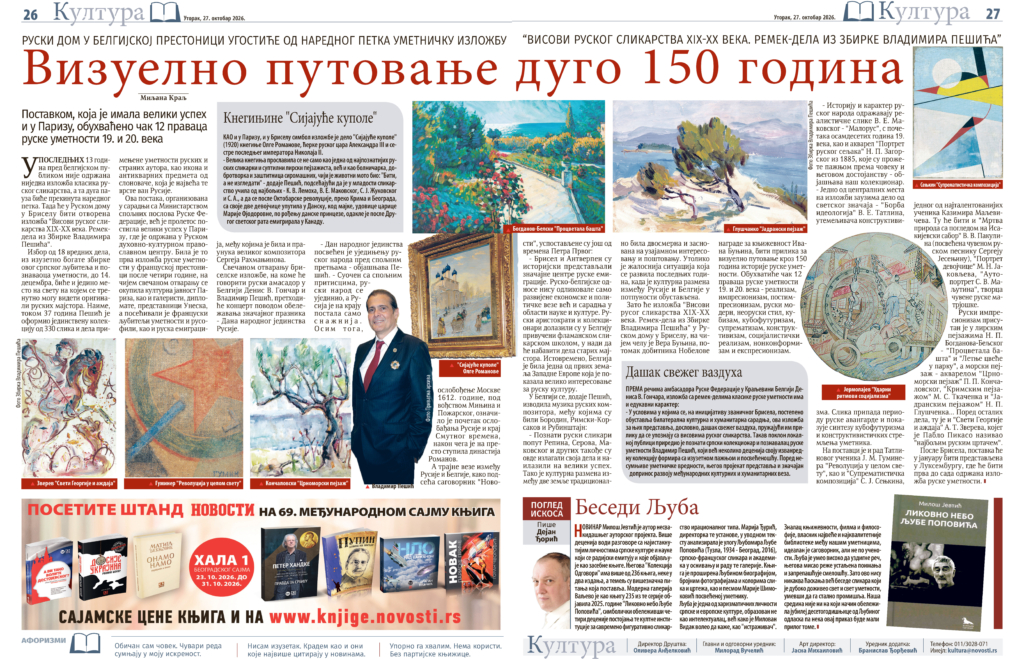
Over the past 13 years, no exhibition of classical Russian painting has been held for Belgian audiences. This long hiatus will come to an end next Friday, when the exhibition “The Splendour of Russian Painting of the 19th–20th Centuries. Masterpieces from the Collection of Vladimir Pesic” opens at the Russian House in Brussels.
A selection of 18 outstanding works from the exceptionally rich collection of this Serbian art enthusiast and connoisseur will be on display until 14 December, making it the only place in the world where original works by the great masters of Russian art can currently be seen. Over the course of 37 years, Pesic has assembled a unique collection of 330 paintings and artworks of applied art by Russian and foreign artists, as well as icons and antique ivory objects, making it the largest collection of its kind outside Russia.
The exhibition, organised in cooperation with the Ministry of Foreign Affairs of the Russian Federation, was already a great success this spring in Paris, where it was hosted by the Russian Spiritual and Cultural Orthodox Centre. It was the first exhibition of Russian art in the French capital in four years. Its grand opening brought together members of Paris’s cultural community, gallery owners, diplomats and UNESCO representatives. The exhibition also attracted French art enthusiasts and admirers of Russian culture, members of the Russian diaspora, including the great composer Sergei Rachmaninoff’s great-granddaughter.
The official opening of the Brussels exhibition, at which Russian Ambassador to Belgium Denis V. Gonchar and Vladimir Pesic will address the guests, will be preceded by a concert marking one of Russia’s major national holidays — National Unity Day.
“National Unity Day commemorates the unity of the Russian people in the face of an external threat,” Pesic explains. “Faced with outside pressure, the Russian people rallied together, and ultimately Russia emerged even stronger. Furthermore, the liberation of Moscow under the leadership of Minin and Pozharsky in 1612 marked the beginning of Russia’s liberation and the end of the Time of Troubles, after which the Romanov dynasty ascended the throne.”
Enduring ties between Russia and Belgium, as my interlocutor from Večernje novosti reminds us, date back to the time of Peter the Great.
“Brussels and Antwerp have historically been major centres of the Russian émigré community. Russian-Belgian relations have been distinguished not only by strong economic and political ties, but also by extensive scientific and cultural cooperation. Russian aristocrats and collectors came to Belgium because of their interest in the Flemish school of painting, hoping to acquire works by the Old Masters. At the same time, Belgium was one of the first countries in Western Europe to show a keen interest in Russian culture.
“Russian composers, including Borodin, Rimsky-Korsakov and Rubinstein, had their music performed in Belgium,” Pesic adds.
“Renowned Russian painters such as Repin, Serov, Makovsky and others also exhibited their works here and enjoyed considerable success. Thus, cultural exchange between the two countries has traditionally been a reciprocal one. All the more regrettable is the situation that has developed in recent years, with cultural exchange between Russia and Belgium having come to a complete standstill.”
That is precisely why the exhibition “The Splendour of Russian Painting of the 19th–20th Centuries. Masterpieces from the Vladimir Pesic Collection”, hosted by the Russian House in Brussels, headed by Vera Bunina, a descendant of Ivan Bunin, the Nobel Prize-winning author, will offer an opportunity to embark on a visual journey through 150 years of Russian art history. It will encompass no fewer than 12 movements in 19th- and 20th-century Russian art: Realism, Impressionism, Post-Impressionism, Russian Art Nouveau, Neo-Russian Style, Cubism, Cubo-Futurism, Suprematism, Constructivism, Socialist Realism, Nonconformism and Expressionism.
“The history and character of the Russian people are reflected in the realistic paintings of V. E. Makovsky — The Little Russian (Maloross), dating from the early 1880s, and Portrait of a Russian Peasant, an 1885 watercolour by N. P. Zagorsky. Both works filled with profound attention to the human being and his inherent dignity,” our collector explains.
“One of the central works in the exhibition is a piece of international significance — The Struggle of Ideologies by V. E. Tatlin, the founder of Constructivism. The painting belongs to the Russian avant-garde of the 1910s–1920s and demonstrates a synthesis of Cubo-Futurism and Tatlin’s Constructivist explorations
“The exhibition also features Revolution Throughout the World by Y. M. Guminer, a student of Tatlin, as well as Suprematist Composition by S. Y. Senkin, one of Kazimir Malevich’s most talented students. Other works include Still Life with a View of St Isaac’s Cathedral by V. V. Pakulin, dedicated to the celebrated Russian poet Sergei Yesenin; Portrait of a Girl by M. N. Yakovlev; and Self-Portrait by S. V. Malyutin, the creator of the famous Russian matryoshka doll.
“Russian Impressionism is represented by the lyrical landscapes of N. P. Bogdanoff-Belsky — Blooming Garden and Summer Flowers in the Park. Seascapes are represented by The Black Sea landscape, a watercolour by P. P. Konchalovsky, Crimean Seascape by M. S. Tkachenko and Adriatic Seascape by N. P. Glushchenko. Among the other works on display is Saint George and the Dragon by A. T. Zverev, whom Pablo Picasso described as ‘the finest Russian draughtsman’.”
Following its presentation in Brussels, the exhibition will travel to Luxembourg in January, where it will be the first exhibition of Russian art ever held there.
A Breath of Fresh Air
According to Denis V. Gonchar, Ambassador of the Russian Federation to the Kingdom of Belgium, the exhibition featuring masterpieces of classical Russian art also has an educational dimension:
“At a time when bilateral cultural and humanitarian cooperation is being curtailed at the initiative of the official Brussels, this exhibition is, quite literally, a breath of fresh air for them, offering an opportunity to experience the splendour of Russian painting.
“This gift to the local public comes from Vladimir Pesic, a renowned Serbian collector and connoisseur of Russian art, who has spent several decades building his brilliant collection with exceptional care and attention. Beyond its evident artistic value, his project also represents an important contribution to the development of international cultural and humanitarian ties.”
The Grand Duchess’s Radiant Domes
As in Paris, the centrepiece of the Brussels exhibition is Radiant Domes (1920) by Grand Duchess Olga Romanova, daughter of Tsar Alexander III of Russia and sister of the last Emperor, Nicholas II.
“The Grand Duchess became renowned not only as one of Russia’s most celebrated female painters and a sensitive, lyrical landscape artist, but also as a nurse, philanthropist and benefactor of the poor. Her personal motto was ‘To be, not to seem’,” Pesic adds.
He recalls that, in her youth, she studied painting under some of the finest masters of the time — K. V. Lemokh, V. E. Makovsky and S. Y. Zhukovsky. Following the October Revolution, she left Russia with her two young daughters, travelling via Crimea and Belgrade to Denmark, where her mother, Dowager Empress Maria Feodorovna, née Princess Dagmar of Denmark, was living. After the Second World War, Olga emigrated to Canada.
Photo Captions
- Grand Duchess Olga Romanova. Radiant Domes.
- A. T. Zverev. Saint George and the Dragon.
- G. E. Guminer. Revolution Throughout the World.
- N. P. Bogdanoff-Belsky. Blooming Garden.
- P. P. Konchalovsky. The Black Sea landscape
- Vladimir Pesic.
- N. P. Glushchenko. Adriatic Seascape.
- S. Y. Senkin. Suprematist Composition.
- B. N. Yermolayev. Urban Rhythm of the Socialism.
Photographs: Vladimir Pesic Collection; personal archive.