Sputnik Serbia

Exhibition of Russian Painting from the 19th and 20th Centuries from the Vladimir Pesic Collection in Brussels
27 October 2026
The exhibition “The Splendour of Russian Painting of the 19th–20th Centuries. Masterpieces from the Collection of Vladimir Pesic” will be open at the Russian House in Brussels from 30 October to 14 December.
Following its great success in Paris, where it was presented during the summer of 2026 at the Russian Spiritual and Cultural Orthodox Centre, the exhibition will now be open to the Belgian public, the organisers announced.
The exhibition in Brussels has been conceived as a visual journey through 150 years of Russian art history. It will feature 18 works representing 12 movements in Russian art of the 19th and 20th centuries: Realism, Impressionism, Post-Impressionism, Russian Art Nouveau, the Neo-Russian Style, Cubism, Cubo-Futurism, Suprematism, Constructivism, Socialist Realism, Nonconformism and Expressionism.
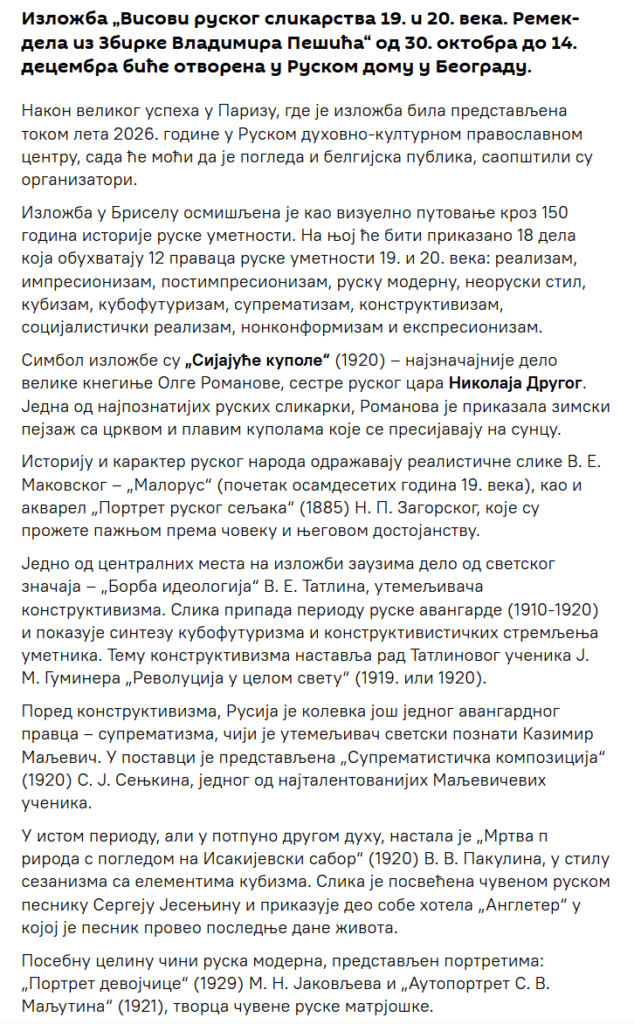
The symbol of the exhibition is “Radiant Domes” (1920) – the most significant work by Grand Duchess Olga Romanova, sister of the Russian Emperor Nicholas II. One of the most recognized Russian female artists, depicted a winter landscape with a church and sunlit blue domes.
The realism of the Russian people’s character and history is reflected in of V. E. Makovsky – “Little Russian (Maloross)” (early 1880s) – and in N. P. Zagorsky’s watercolour “Portrait of a Russian Peasant” (1885), both imbued with a deep regard for the individual and human dignity.
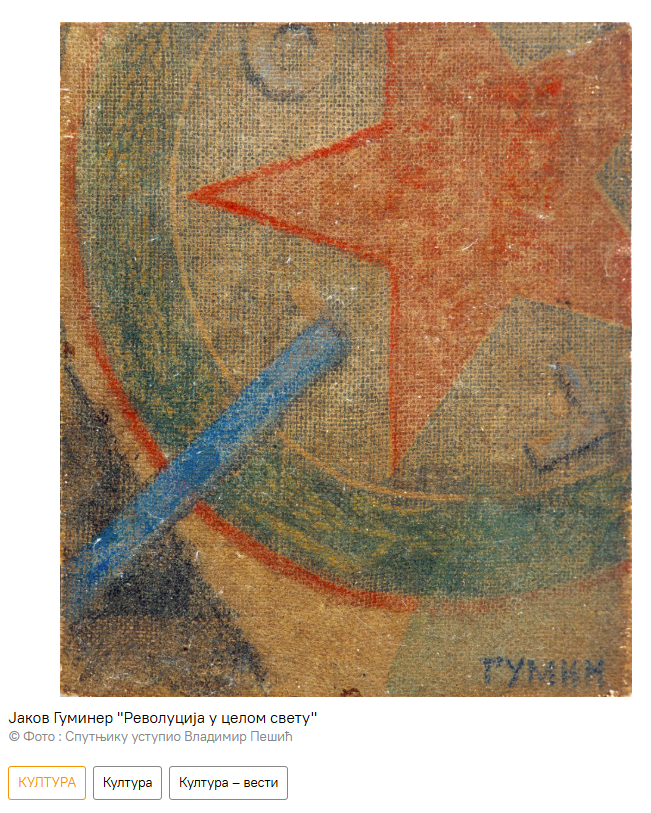
One of the central works in the exhibition is a painting of international significance: “The Struggle of Ideologies” by V. E. Tatlin, the founder of Constructivism. The painting belongs to the Russian avant-garde of the 1910s–1920s and demonstrates a synthesis of Cubo-Futurism and Tatlin’s Constructivist explorations. The theme of Constructivism continues with Revolution Throughout the World (1919 or 1920) by Tatlin’s student Yakov Guminer.
Alongside Constructivism, Russia was also the birthplace of another avant-garde movement – Suprematism, founded by the world-renowned Kazimir Malevich. The exhibition features Suprematist Composition (1920) by Sergey Senkin, one of Malevich’s most gifted students.
To the same period, but to a very different artistic direction, belongs Still Life with a View of St. Isaac’s Cathedral (1920s) by V. V. Pakulin, executed in the style of Cézannism with elements of Cubism. The painting is dedicated to the famous Russian poet Sergei Yesenin and depicts part of the room of the Angleterre Hotel where Yesenin spent the last days of his life.
A distinct section is devoted to Russian Art Nouveau, represented by two portraits: “Portrait of a Girl” (1929) by M. N. Yakovlev and “Self-Portrait” (1921) by S. V. Malyutin, the creator of the famous Russian matryoshka doll.
Russian Impressionism is represented by the lyrical landscapes of N. P. Bogdanoff-Belsky – “Blooming Garden” and “Summer Flowers in the Park” (1930) – filled with light and air. F. F. Fyodorovsky, one of the leading stage designers and chief artist of the Bolshoi Theatre, worked in the Neo-Russian Style, inspired by epic narratives and fairy-tale motifs. His set-design sketch for the opera “Sadko” (1934) is on display.
The exhibition is complemented by seascapes. “The Black Sea landscape” (1929), a watercolour by P. P. Konchalovsky, one of the most significant masters of Russian and Soviet art in the first half of the 20th century, depicts the sunlit coastline of Gurzuf in Crimea. The Crimean theme continues in “Crimean Seascape” (1897) by M. S. Tkachenko, an artist who lived in Paris but travelled to Crimea every year to paint outdoors.
This is followed by “Adriatic Seascape” (1966) by N. P. Gloutchenko, a renowned Soviet painter and intelligence agent who was among the first to inform the Soviet government, in January 1940, of the impending attack by Nazi Germany.
Socialist Realism is represented by B. N. Yermolayev’s “Urban Rhythm of the Socialism” (1937), which captures the dynamism of the industrial age. A later period of Soviet art is represented by “Sailboat Regatta” (1960) by G. E. Dontsov, a Post-Impressionist work distinguished by its rich palette and dynamic composition.
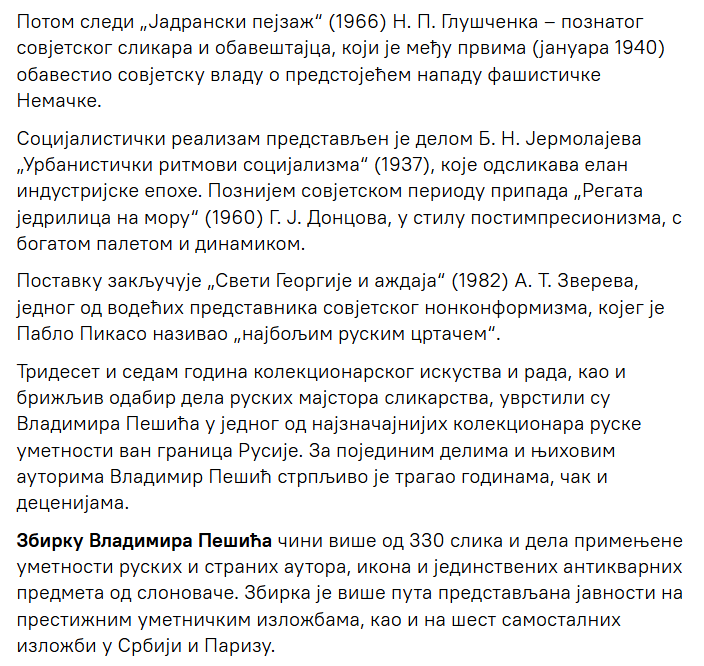
The exhibition concludes with “Saint George and the Dragon” (1982) by A. T. Zverev, one of the leading figures of Soviet Nonconformism, whom Pablo Picasso described as “the best Russian draftsman”.
Thirty-seven years of collecting experience and dedicated work, together with the meticulous selection of works by Russian masters, have made Vladimir Pesic one of the most significant collectors of Russian art outside Russia. In its level and curatorial concept, this Collection goes far beyond the scope of an ordinary private collection: thanks to the impeccably considered selection of artists and artworks, many of which Pesic patiently pursued for years, sometimes even decades
The Collection of Vladimir Pesic comprises over 330 artworks of Russian and foreign painting and applied arts, icons, and unique antique ivory objects. Pieces from the Collection have been featured numerous times at prestigious art exhibitions, as well as in five solo exhibitions in Serbia and Paris.